Model
✨ Discover FIBO on Hugging Face
RMBG v2.0 is our new state-of-the-art background removal model significantly improves RMBG v1.4. The model is designed to effectively separate foreground from background in a range of categories and image types. This model has been trained on a carefully selected dataset, which includes: general stock images, e-commerce, gaming, and advertising content, making it suitable for commercial use cases powering enterprise content creation at scale. The accuracy, efficiency, and versatility currently rival leading source-available models. It is ideal where content safety, legally licensed datasets, and bias mitigation are paramount.
→ Try the API Sandbox (no signup required)
Developed by BRIA AI, RMBG v2.0 is available as a source-available model for non-commercial use.
Bria RMBG2.0 is availabe everywhere you build, either as source-code and weights, ComfyUI nodes or API endpoints.
For production / commercial deployment, use the Bria API — same RMBG-2.0 quality, fully licensed, zero infrastructure:
| Use | Self-Hosted (HF Weights) | Bria API |
|---|---|---|
| Quality | ✅ RMBG-2.0 | ✅ RMBG-2.0 |
| Commercial License | ❌ Requires agreement | ✅ Included |
| GPU Infrastructure | ❌ You manage | ✅ Managed |
| Legally Licensed Data | ✅ Yes | ✅ Yes |
| Setup Time | Hours | Minutes |
→ Try the API Sandbox — test it live, no signup required.
API Endpoint: Sandbox
Purchase: To purchase a Self-Hosted (HF Weights) commercial license Click Here.
For more information, please visit our website.
Join our Discord community for more information, tutorials, tools, and to connect with other users!

Bria-RMBG model was trained with over 15,000 high-quality, high-resolution, manually labeled (pixel-wise accuracy), fully licensed images. Our benchmark included balanced gender, balanced ethnicity, and people with different types of disabilities. For clarity, we provide our data distribution according to different categories, demonstrating our model’s versatility.
| Category | Distribution |
|---|---|
| Objects only | 45.11% |
| People with objects/animals | 25.24% |
| People only | 17.35% |
| people/objects/animals with text | 8.52% |
| Text only | 2.52% |
| Animals only | 1.89% |
| Category | Distribution |
|---|---|
| Photorealistic | 87.70% |
| Non-Photorealistic | 12.30% |
| Category | Distribution |
|---|---|
| Non Solid Background | 52.05% |
| Solid Background | 47.95% |
| Category | Distribution |
|---|---|
| Single main foreground object | 51.42% |
| Multiple objects in the foreground | 48.58% |
Open source models comparison
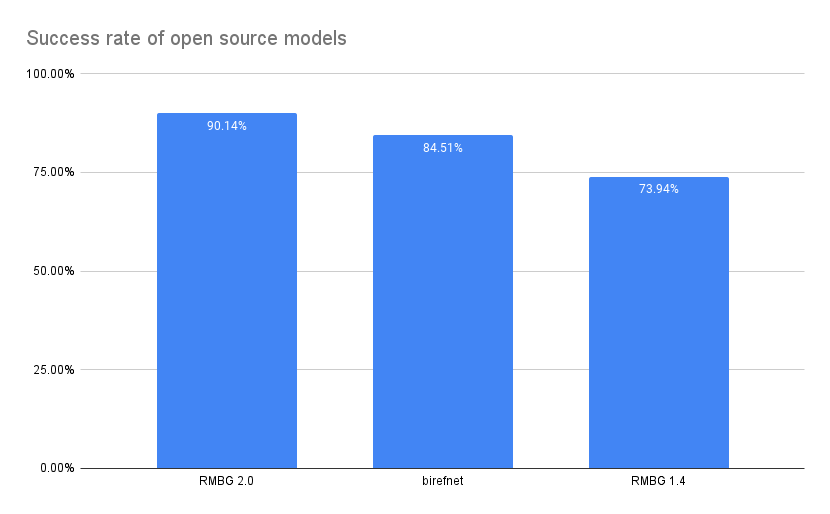

RMBG-2.0 is developed on the BiRefNet architecture enhanced with our proprietary dataset and training scheme. This training data significantly improves the model’s accuracy and effectiveness for background-removal task. If you use this model in your research, please cite:
@article{BiRefNet,
  title={Bilateral Reference for High-Resolution Dichotomous Image Segmentation},
  author={Zheng, Peng and Gao, Dehong and Fan, Deng-Ping and Liu, Li and Laaksonen, Jorma and Ouyang, Wanli and Sebe, Nicu},
  journal={CAAI Artificial Intelligence Research},
  year={2024}
}
torch
torchvision
pillow
kornia
transformers
from PIL import Image
import torch
from torchvision import transforms
from transformers import AutoModelForImageSegmentation

device = 'cuda' if torch.cuda.is_available() else 'cpu'
model = AutoModelForImageSegmentation.from_pretrained('briaai/RMBG-2.0', trust_remote_code=True).eval().to(device)

# Data settings
image_size = (1024, 1024)
transform_image = transforms.Compose([
    transforms.Resize(image_size),
    transforms.ToTensor(),
    transforms.Normalize([0.485, 0.456, 0.406], [0.229, 0.224, 0.225])
])

image = Image.open(input_image_path)
input_images = transform_image(image).unsqueeze(0).to(device)

# Prediction
with torch.no_grad():
    preds = model(input_images)[-1].sigmoid().cpu()
pred = preds[0].squeeze()
pred_pil = transforms.ToPILImage()(pred)
mask = pred_pil.resize(image.size)
image.putalpha(mask)

image.save("no_bg_image.png")